



Last updated: October 14, 2026
Key Takeaways (TL;DR)
- Best doola alternative overall: Globalfy combines LLC or Corp formation with ongoing compliance, human support in English, Portuguese and Spanish and a named account executive, while doola’s support runs mainly in English and charges separately for much of what Globalfy already includes.
- Why look for a doola alternative: non-resident founders run into Stripe and PayPal blocks on accounts tied to companies outside the U.S., questions about double taxation between their country and the U.S., and support that doesn’t solve problems in their own language; doola doesn’t cover any of those three points natively.
- Who it’s for: SaaS founders, Amazon FBA and dropshipping sellers, info-product creators (Hotmart), consultants and freelancers who bill in U.S. dollars without leaving their home country.
- How to choose the right alternative: compare the total first-year cost (not just the monthly fee), the real language of support (not the promise of “international support”) and what’s left out of the plan – ITIN, Sales Tax, multi-member filings.
- Expected price range: Globalfy’s annual plans run from $588 (company formation and address services) to $5,028 and up (Scale, with monthly bookkeeping); the market for doola alternatives ranges from $0 + state fees to $2,999/year (doola Business-in-a-Box™).
doola Alternatives in 2026 at a Glance
| Company | Best for | Key features | Price |
| Globalfy | Non-resident founders who want support in their language and ongoing compliance | Formation + EIN + U.S. address + compliance calendar + account executive + free Fynance | $588–5,028+/year |
| Firstbase | Startups raising capital in Delaware or Wyoming | Fast formation, AI co-founder, credits marketplace | $399 + subscription add-ons |
| StartGlobal | Founders who want a single fixed price, with no mandatory subscription | All-in formation, à la carte or managed compliance | $399 + $99/year or $149/month |
| LegalZoom | Those who know the brand and want one-off legal services | Formation, registered agent, legal documents | $0–299 + add-ons |
| ZenBusiness | U.S.-based founders who want a guided dashboard | Formation, Worry-Free Compliance, EIN | $0–349/year |
What Is a doola Alternative?
doola is a U.S. back-office platform for non-resident founders: it forms the LLC or C-Corp, gets the EIN, provides a business address and, on its pricier plans, adds bookkeeping and tax filing. A doola alternative is any service that covers that same cycle – formation, EIN, registered agent, banking and annual compliance – but with an adjustment that makes sense for founders who don’t speak English as a first language.
For non-resident founders, that means something specific: human support in a language they’re comfortable with, able to explain Form 5472, how an Operating Agreement differs from the company documents they know at home, and the difference between an LLC and a Corporation without relying on machine translation.
Why Look for a doola Alternative as a Non-Resident?
The most common trigger isn’t price. It’s Stripe or PayPal blocking or limiting an account tied to a company or individual outside the U.S., and the founder realizing they need a U.S. entity to keep getting paid in dollars. That pattern shows up often in the industry’s sales conversations: pressure from the payment provider, not a desire to “have an American company” for status.
The second reason is the fear of getting something wrong with the IRS from a distance. Failing to file Form 5472 for a foreign-owned single-member LLC can trigger a penalty of more than $25,000, even if the company earned nothing that year. doola charges separately for that kind of protection; on its entry plans, it simply doesn’t exist.
Add double taxation between your country and the U.S. – one of the most frequent questions in the industry’s sales calls, especially among founders who already run a company at home – and it becomes clear why “forming the LLC” is only the first step. The following year, with the Annual Report, Franchise Tax and federal forms, is when most formation providers disappear.
Who Is a doola Alternative For?
Remote SaaS founder
Charges subscriptions to customers in the U.S. and worldwide and needs credibility with payment processors and investors, without giving up correct compliance from day one.
Amazon FBA and dropshipping seller
Needs an LLC to meet marketplace and payment processor requirements, and to avoid account suspension over incomplete documentation.
Info-product creator (Hotmart and similar)
Wants to get paid in dollars, reduce platform withholding and simplify the tax structure, usually with little patience for handling English-language forms alone.
Consultant or freelancer serving U.S. clients
Wants a professional U.S. presence, a bank account and simple invoicing, without hiring a separate U.S. accountant.
Founder raising capital from U.S. investors
Is forming or converting to a Delaware C-Corp and needs a clean cap table from day one – the audience most likely to come across Firstbase or Stripe Atlas in their research.
The Best doola Alternatives: Full Review
1. Globalfy
Overview
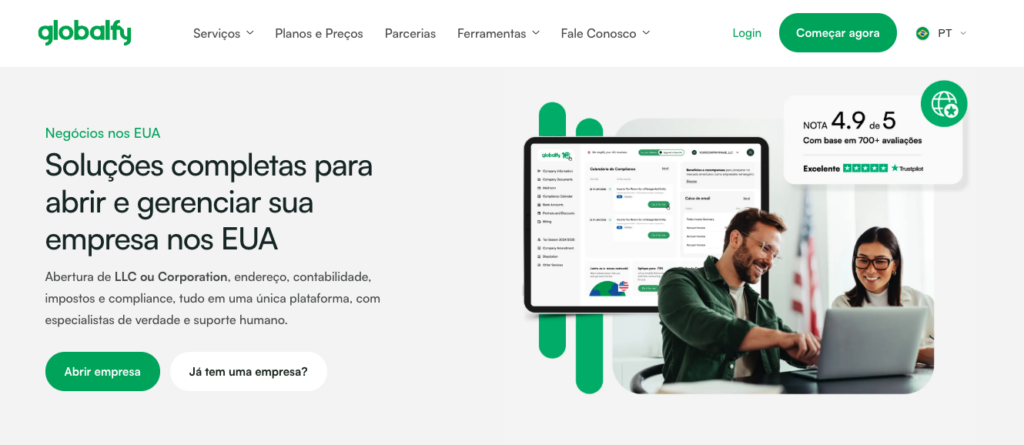
Globalfy is a complete platform for forming and operating a U.S. LLC or C-Corporation, created in 2015 specifically for non-resident founders. It brings company formation, EIN, business address, registered agent, compliance calendar and federal filings together in a single dashboard, depending on the plan, with human support in English, Portuguese and Spanish. It has supported more than 10,000 founders in more than 100 countries, with Brazil as its largest market.
Best for
- Founders who’ve tried to handle everything on their own in a second language and given up halfway.
- Founders who want a named account executive, not a ticket queue.
- Businesses that know they’ll need compliance year after year, not just at launch.
- Founders moving an LLC they formed on their own or through a formation-only competitor.
Key features
- State registration in Wyoming, Delaware, Florida, Texas, Nevada, or New Mexico.
- Compliance calendar with automatic reminders for the Annual Report, Franchise Tax, and federal deadlines.
- Banking assistance with Mercury, Lili and Revolut, including applications before the EIN is issued.
- Free Fynance license (AI bookkeeping, $360 value) included in the plans.
Why it stands out
Globalfy was built to solve the opposite problem to doola’s: not “form fast and walk away”, but staying with the founder through the following years, when federal and state obligations show up. The case of Douglas Negrisolli of L8Cup, a client for ten consecutive years, is the most concrete example: retention, not just formation, is what sustains its 4.9/5 rating from more than 700 Trustpilot reviews.
Covering “only” six states often looks like a limitation next to competitors that serve all 50, until you notice that nearly half of Globalfy’s clients (~40%) choose Wyoming, and the rest are spread across Delaware, Florida, Texas, Nevada and New Mexico. Those six states cover the vast majority of real non-resident founder cases; the other 44 states come up almost only in very specific scenarios.
Pros
- Human support in English, Portuguese or Spanish with a named account executive, not a chatbot.
- Compliance calendar, registered agent and federal filings included in all plans except Starter, which covers company formation and address services only.
- More than $200k in partner credits: just adding up the Stripe discount (up to $500), the OpenAI credit ($1,000), the Google Ads credit ($1,000 when you spend $1,500) and the free Fynance license ($360) already covers a good part of the annual Remote subscription.
- Over 11 years of experience and a strong event presence across Latin America and Europe.
Cons
- Covers six states (Wyoming, Delaware, Florida, Texas, Nevada, New Mexico): founders who need a state outside that list won’t find support here.
- The Remote plan has clear exclusions: it doesn’t cover LLCs with multiple members, physical presence in the U.S., B2B/e-commerce sales to American customers, or U.S.-source investment income.
- It isn’t the cheapest option for formation alone; the argument is the total cost of keeping the company compliant, not the entry price.
Pricing
Annual plans by business profile: Starter ($588, company formation and address services), Remote ($998, 100% remote solo founder), Essential ($1,308, multiple members or U.S. presence), and Scale (from $5,028, with dedicated monthly bookkeeping). State formation and renewal fees are extra and vary by state.
Final verdict
For a non-resident comparing against doola, Globalfy solves the problem that shows up most after formation: staying current with the IRS and the state, in your language, without having to hire three more providers along the way.
2. Firstbase
Overview
Firstbase is a platform aimed at startups seeking fast formation in Delaware or Wyoming, with an AI co-founder and a credits marketplace valued at more than $350k. It has formed more than 30,000 companies in 191 countries.
Best for
- Startups that will raise capital from U.S. investors.
- Founders who want to form fast and decide later which recurring services to buy.
- Businesses that don’t need support in a language other than English.
Key features
- Formation in one day, with expedited EIN and post-formation documents included.
- Credits marketplace with Stripe, Carta, AWS and Mercury.
- Firstbase One, a single package combining agent, mail, bookkeeping and taxes.
Why they stand out
Firstbase is one of the strongest options for founders who prioritize formation speed and then build their service stack themselves, an à la carte model that gives control to those who know exactly what they need.
Cons
- Only forms companies in Delaware or Wyoming, which limits founders who need another state.
- Recurring bookkeeping ($599/month) and tax filing ($1,799/year) cost more than equivalent plans from non-resident-focused competitors.
- No native Portuguese or Spanish support.
Pricing
Start formation at $399 (one-time fee), registered agent $299/year, Mailroom from $35/month, Accounting $599/month, Tax Filing $1,799/year. The Firstbase One package bundles everything for $199/month (about $2,388/year).
Final verdict
Worth it for founders who already know they’ll raise investment and don’t mind building their service stack piece by piece. Not the right choice for those who want a single, predictable annual price.
3. StartGlobal
Overview
StartGlobal is a newer platform built specifically for non-resident founders, with a single-price model: a fixed formation fee, and compliance sold à la carte or in a managed plan.
Best for
- Founders who prefer to pay once for formation, with no mandatory subscription.
- Those who want all state fees already included in the advertised number.
- Small businesses that don’t need monthly bookkeeping yet.
Key features
- Formation with state fees included in a single price.
- EIN without an SSN, with bank account opening through partners such as Mercury.
- À la carte compliance (registered agent, Annual Report) or a fixed monthly plan.
Why they stand out
StartGlobal is one of the most price-transparent competitors: the advertised price already covers the state fee, which avoids the common surprise with providers that charge the state fee separately.
Cons
- A newer brand, with a shorter track record than doola, Firstbase or Globalfy.
- English-only support.
- Bookkeeping and tax filing priced by transaction volume or revenue, which makes the total first-year cost hard to predict.
Pricing
Formation for $399 (state fees included), à la carte compliance from $99/year per service, or a managed plan at $149/month covering bookkeeping, the Annual Report and the federal return.
Final verdict
An honest option for founders who value price predictability at formation. Even so, it doesn’t solve the language barrier or offer the established support track record that weighs in non-resident founders’ decisions.
4. LegalZoom

Overview
LegalZoom is one of the best-known brands in the U.S. legal sector, with a broad catalog that goes beyond company formation – including wills, trademarks and attorney consultations.
Best for
- Those who already know the brand and want formation and other legal services in one place.
- U.S.-based founders who don’t have the same requirements as a non-resident.
- Businesses that value brand recognition over price.
Key features
- Free formation on some plans, plus the state fee.
- One-off legal consultations and documents such as contracts and trademarks.
- Registered agent and compliance calendar service.
Why they stand out
LegalZoom’s brand recognition is real – decades on the market and a legal services catalog few competitors replicate.
Cons
- Registered agent costs $249/year, the most expensive among traditional competitors.
- Constant upsells throughout checkout, a pattern often cited in industry comparisons.
- Not designed for non-residents’ specific requirements, such as Form 5472 and 1040NR.
- Support in English.
Pricing
Formation plans from $0 to $299, plus the state fee; registered agent $249/year; Annual Report from $199/year.
Final verdict
It makes sense for those who want the best-known name on the market and will use other services from the legal catalog. Not the right choice for those seeking cost predictability or support in their native language.
5. ZenBusiness
Overview
ZenBusiness is a formation platform aimed mainly at U.S.-based founders, with a guided dashboard and the Worry-Free Compliance program for deadline reminders.
Best for
- First-time founders who want a guided visual dashboard.
- Businesses with partners or operations already based in the U.S.
- Those who prioritize a low entry price and accept reviewing renewals later.
Key features
- Starter plan at $0 plus the state fee.
- Worry-Free Compliance, free in the first year.
- EIN and formation documents on mid-tier plans.
Why they stand out
ZenBusiness’s guided dashboard is one of the easiest to use among competitors aimed at U.S.-based founders, an experience designed for people who have never formed a company before.
Cons
- Worry-Free Compliance renewal rises to about $199/year after the free first year, a common surprise among users.
- Not built for non-residents’ requirements, with no native support for Form 5472 or an EIN without an SSN.
- Support in English.
Pricing
Starter $0 + state fee, Pro about $199/year, Premium about $349/year (includes registered agent).
Final verdict
A solid option for founders already living in the U.S. For those living abroad who need an EIN without an SSN and guidance on non-resident taxation, ZenBusiness leaves important gaps unanswered.
How to Choose the Right doola Alternative?
1. Check the real language of support, not just “international coverage”
Many providers advertise service to “customers worldwide”, but that doesn’t mean support in your language. Before signing up, ask whether there’s an account executive who speaks your language, not just an email team using machine translation.
2. Calculate the total cost of year one and year two
The formation price is only the tip of the iceberg. Add the registered agent, business address, the state’s Annual Report or Franchise Tax and the federal return – many of these items are sold separately at doola and at most U.S. competitors.
3. Confirm the provider understands double taxation between your country and the U.S.
A provider that has never handled clients from your country is unlikely to warn you about the points of attention between your home tax authority and the IRS. Ask directly whether the team has dealt with this before.
4. Look at the annual maintenance cost of your chosen state, not how many states the provider covers
Serving all 50 states doesn’t help if your business only needs one. What hits your wallet is that specific state’s annual report or franchise tax – Wyoming, for example, costs much less to maintain than Delaware.
5. Check what’s left out of the plan before signing
ITIN, Resale Certificate, Sales Tax and multi-member filings are usually left out of entry plans at virtually every provider. Ask for the full list in writing before signing, and notice which provider gives you that list without hedging. In analyses of more than 260 sales calls, transparency about what is and isn’t included is the attribute most spontaneously cited by those who signed with Globalfy.
6. Use partner credits as part of the math
Several providers, including Globalfy, offer credits on tools such as Stripe, OpenAI and Google Ads that can cover a real share of the annual subscription – it’s worth adding that in when comparing prices.
doola vs Competitors: Everything You Need to Know
| Company | Pros | Cons | Ease of use | Integrations | Support | Value for money |
| Globalfy | Support in EN/PT/ES, compliance included, account executive | Covers 6 states, Remote plan exclusions | ⭐⭐⭐⭐ | ⭐⭐⭐⭐ | ⭐⭐⭐⭐⭐ | ⭐⭐⭐⭐ |
| Firstbase | Fast formation, credits marketplace | Delaware/Wyoming only, expensive add-ons | ⭐⭐⭐⭐ | ⭐⭐⭐⭐ | ⭐⭐⭐ | ⭐⭐⭐ |
| StartGlobal | Fixed price with state fee included | Newer brand, English-only support | ⭐⭐⭐⭐ | ⭐⭐⭐ | ⭐⭐⭐ | ⭐⭐⭐⭐ |
| LegalZoom | Recognized brand, broad legal catalog | Expensive agent, upsells, no non-resident focus | ⭐⭐⭐ | ⭐⭐⭐ | ⭐⭐⭐ | ⭐⭐ |
| ZenBusiness | Simple dashboard, free entry plan | Renewals go up, no non-resident focus | ⭐⭐⭐⭐ | ⭐⭐⭐ | ⭐⭐⭐ | ⭐⭐⭐ |
Form Your U.S. Company With Globalfy
Switching providers midway costs time updating the registered agent, address and details with the state and the IRS. Globalfy already handles exactly that migration for founders coming from an LLC they formed on their own or through a formation-only competitor, without losing the company’s history.
The difference isn’t forming faster. It’s continuing to answer your questions in your language in the second, third and tenth year of operation, as happened with Douglas Negrisolli of L8Cup, a Globalfy client for ten years.
Compare Globalfy’s plans and see which one fits your business profile, or talk to a specialist before deciding.
Frequently asked questions
What is the best doola alternative for non-resident founders?
The best doola alternative for non-resident founders is Globalfy, because it combines LLC or Corp formation with ongoing compliance (included in the Remote, Essential and Scale plans; Starter covers company formation and address services only) and human support in English, Portuguese and Spanish, which doola doesn’t offer natively. Globalfy has supported more than 10,000 founders in more than 100 countries, with a 4.9/5 Trustpilot rating from more than 700 reviews. For founders whose Stripe or PayPal account tied to a company outside the U.S. has already been blocked, support in their own language to sort out the EIN and documentation makes a direct difference to the time until the first sale in dollars. The right plan depends on your profile: remote solo founder, multiple members or already meaningful revenue.
Is there double taxation between my country and the U.S. when I open an LLC?
There can be, but in most cases it can be avoided with the right structure. A non-resident single-member LLC, taxed as a disregarded (pass-through) entity, usually generates no U.S. federal income tax on profits not connected to U.S. activity, but it still requires filing Form 5472 every year, even with zero revenue. In your country of residence, the profits are taxed under local rules, which in many countries tax residents on their worldwide income. A provider experienced with clients from your country can guide the structure before formation, not after an IRS notice.
How long does it take to open a company in the U.S.?
The time varies by state: Wyoming takes 1 to 7 business days for state registration, while Florida can take 25 to 30 business days. After registration, the EIN usually comes through in 2 to 3 business days when the process is handled by a specialist who deals with applications without an SSN. You don’t need a U.S. visa – just a passport. Providers promising an “EIN in 24 hours” are usually describing the submission, not the actual issuance by the IRS.
Does doola have hidden fees?
doola doesn’t hide its prices, but the tiered structure surprises anyone who doesn’t read the table carefully. The $297/year Starter plan covers only formation, EIN and registered agent. The Annual Report, tax filing and bookkeeping only come in from the $1,999/year plan. Anyone who signs up for Starter thinking compliance is covered finds out otherwise at the first state deadline notice. It’s worth comparing the cost of the plan that actually covers compliance, not just the advertised entry price.
What is it like to move an existing LLC to another provider?
Migration, called “switch company” by most providers, involves updating the address, registered agent and contact details with the state and the IRS. You don’t need to form a new company or lose your existing EIN. The process usually takes a few business days when the destination provider is experienced with this kind of transition. Before migrating, confirm that the new provider can locate and transfer all the original formation documents.
What’s left out of these alternatives’ entry plans?
At most doola alternatives, entry plans don’t include ITIN, Resale Certificate, Sales Tax or multi-member filings – all charged separately, at prices ranging from $195 to $275 per service. That applies to doola as well as to Firstbase, StartGlobal and competitors aimed at U.S.-based founders. Asking for the full list of exclusions before signing avoids surprises at the first-year renewal.