



Updated October 14, 2026
You formed, or are thinking of forming, an LLC through Bizee (formerly Incfile). The registration itself was quick and cheap. The problem showed up later: you’re a non-resident, you have partners or customers outside the U.S., and nobody at Bizee told you who will prepare Form 5472 next year.
That gap is why so many people look for a Bizee alternative for non-residents. It’s not that Bizee is bad. It’s that it was designed for people who already live in the U.S. and can deal with the IRS on their own. For someone in Brazil, Mexico, Germany or any other country, that changes the whole equation.
In this guide, we compare Bizee with five alternatives used by international founders, including Globalfy, looking at what really matters in this scenario: non-resident tax filing, support in your language, and the total cost after the first year.
Key Takeaways (TL;DR)
- The best overall Bizee alternative for non-residents: Globalfy brings company formation, registered agent, bank account and non-resident tax filings (5472 + pro-forma 1120, 1040NR) into a single dashboard, depending on the plan, with human support in English, Portuguese and Spanish.
- Why you need it: a non-resident who doesn’t file Form 5472 faces a $25,000 penalty per year, even with no revenue. Bizee doesn’t include this service in any of its plans.
- Who it’s for: founders of SaaS companies, e-commerce stores, info-product businesses, remote consultants and startups raising capital in the U.S., all without U.S. residency.
- How to choose the right alternative: check three things before deciding: whether the provider prepares non-resident federal filings, which languages support is offered in, and what’s left out of the advertised price.
- Expected price: Globalfy’s Starter plan (company formation and address services) starts at $588/year; Remote, with compliance and federal filings, costs $998/year. Across the market, a Bizee alternative for non-residents ranges from $0 (plus state fee) to more than $5,000/year, depending on how much compliance is included.
Bizee Alternatives for Non-Residents in 2026 at a Glance
| Company | Best For | Key Features | Price |
| Globalfy | Non-residents who want formation + compliance + taxes in one place | Support in English/Portuguese/Spanish, 5472/1120/1040NR filings, account with Mercury, Lili or Revolut, compliance calendar | $588 to $1,308/year (Scale from $5,028) |
| Stripe Atlas | Tech startups that will raise capital in Delaware | C-Corp formation, EIN, 83(b) election, partner credits | ~$500 one-time + ~$100/year for the agent |
| Firstbase | International founders willing to assemble compliance themselves | Fast formation, digital mail, one-off add-ons | ~$399 formation + add-ons from ~$299/year |
| doola | Remote founders who want an all-inclusive subscription | Formation, bookkeeping, and tax filing bundled | From ~$297/year; full plan ~$1,999/year |
| LegalZoom | Those who want access to attorneys for broad legal questions | Legal consultations, document templates, trademarks | $0 to $299 + registered agent extra |
What Is a Bizee (Incfile) Alternative for Non-Residents?
Bizee is Incfile after its 2023 rebrand – same company, same team, new name. Founded in Houston in 2004, it has formed more than a million companies and has one of the largest review bases in the industry on Trustpilot. The model is simple: free formation (you pay only the state fee), with paid plans that add the EIN, Operating Agreement and a year of registered agent.
The problem isn’t what Bizee offers. It’s what it leaves out.
A Bizee alternative for non-residents is any provider built around the specific obligations of people who don’t live in the U.S.: preparing and filing Form 5472, choosing a state and entity structure without a U.S. CPA at hand, and opening a bank account without an SSN. Bizee handles the registration part. An Incfile alternative designed for this audience handles the whole year after registration.
Why Look for a Bizee Alternative?
The tax risk is real, and it’s silent. A 100% foreign-owned single-member LLC has to file Form 5472 together with a pro-forma Form 1120 every year – even with no revenue, even before a bank account is open. The penalty for not filing starts at $25,000, and the IRS doesn’t warn you first.
Bizee doesn’t prepare this filing. None of its plans cover the 5472, pro forma 1120, or 1040NR. Foreigners who form a company there need to hire an accountant separately, coordinate deadlines on their own, and hope they don’t forget anything.
Language matters too. Bizee supports customers in English and Spanish – a real differentiator compared with many U.S. competitors. But it doesn’t support Portuguese, and neither language option comes with specialists in non-resident tax obligations.
Then there’s the checkout pattern. Several independent reviews of Bizee mention aggressive upsells during purchase and a standard formation process that can take three to four weeks when the order isn’t expedited. For people already dealing with time zones, exchange rates, and an English-only IRS, every extra layer of friction weighs more.
Who Needs a Bizee Alternative for Non-Residents?
Remote SaaS Founders
Teams of one to three partners selling software subscriptions to global customers. They need to bill in dollars and look trustworthy to payment processors such as Stripe, without giving up control of the company.
Cross-Border E-commerce Sellers
Those selling through Amazon FBA, Shopify or dropshipping to the U.S. market. A U.S. LLC is often required by the marketplace itself, and the Sales Tax bill arrives as soon as revenue grows.
Info-Product Creators
Those selling courses or digital products internationally, often through platforms such as Hotmart. The priority here is simplicity: getting paid in dollars, reducing withholding at source, and not drowning in red tape.
Consultants and Freelancers
Independent professionals serving U.S. clients, often working from anywhere in the world. They want a professional U.S. presence, a bank account and simple invoicing, without unnecessary complexity.
Startups Raising Capital
Founders forming or converting to a Delaware C-Corp because a U.S. investor requires that structure. The profile is more sophisticated and the compliance bar is higher from day one.
Bizee vs. Competitors: Detailed Review of the Alternatives
1. Globalfy
Overview
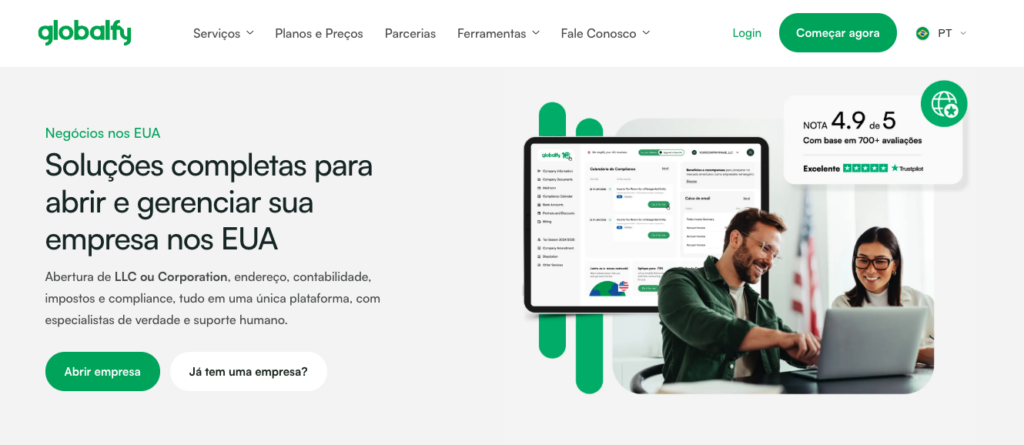
Globalfy is a complete platform for forming and operating a U.S. LLC or C-Corporation, created in 2015 specifically for non-resident founders. It brings company formation, EIN, business address, registered agent, compliance calendar and federal filings together in a single dashboard, depending on the plan, with human support in English, Portuguese and Spanish. It has supported more than 10,000 founders in more than 100 countries, with Brazil as its largest market.
Best For
- Founders who’ve tried to handle everything on their own in a second language and given up halfway.
- Founders who want a named account executive, not a ticket queue.
- Businesses that know they’ll need compliance year after year, not just at launch.
- Founders moving an LLC they formed on their own or through a formation-only competitor.
Key Features
- State registration in Wyoming, Delaware, Florida, Texas, Nevada, or New Mexico.
- Compliance calendar with automatic reminders for the Annual Report, Franchise Tax, and federal deadlines.
- Banking assistance with Mercury, Lili and Revolut, including applications before the EIN is issued.
- Free Fynance license (AI bookkeeping, $360 value) included in the plans.
Why It Stands Out
Globalfy was built not to “form fast and walk away”, but to stay with the founder through the following years, when federal and state obligations show up. The case of Douglas Negrisolli of L8Cup, a client for ten consecutive years, is the most concrete example: retention, not just formation, is what sustains its 4.9/5 rating from more than 700 Trustpilot reviews. Covering “only” six states often looks like a limitation next to competitors that serve all 50, until you notice that nearly half of Globalfy’s clients (~40%) choose Wyoming, and the rest are spread across Delaware, Florida, Texas, Nevada and New Mexico. Those six states cover the vast majority of real non-resident founder cases.
Pros
- Human support in English, Portuguese or Spanish with a named account executive, not a chatbot.
- Compliance calendar, registered agent and federal filings included in all plans except Starter, which covers company formation and address services only.
- More than $200k in partner credits: just adding up the Stripe discount (up to $500), the OpenAI credit ($1,000), the Google Ads credit ($1,000 when you spend $1,500) and the free Fynance license ($360) already covers a good part of the annual Remote subscription.
- Over 11 years of experience and a strong event presence across Latin America and Europe.
Cons
- Covers six states (Wyoming, Delaware, Florida, Texas, Nevada, New Mexico): founders who need a state outside that list won’t find support here.
- The Remote plan has clear exclusions: it doesn’t cover LLCs with multiple members, physical presence in the U.S., B2B/e-commerce sales to American customers, or U.S.-source investment income. It isn’t the cheapest option for formation alone; the argument is the total cost of keeping the company compliant, not the entry price.
Pricing
Annual plans by business profile: Starter ($588, company formation and address services), Remote ($998, 100% remote solo founder), Essential ($1,308, multiple members or U.S. presence), and Scale (from $5,028, with dedicated monthly bookkeeping). State formation and renewal fees are extra and vary by state; on Globalfy’s plans and prices page you can check the exact amount for your profile.
Final Verdict
For a non-resident comparing against Bizee, Globalfy solves the problem that shows up most after formation: staying current with the IRS and the state, in your language, without having to hire three more providers along the way. The Form 5472 filing for non-residents is included in the Remote, Essential and Scale plans.
2. Stripe Atlas

Overview
Launched by Stripe in 2016, Atlas forms a Delaware C-Corporation and delivers the EIN, registration, and standard paperwork for founders who will raise U.S. venture capital. It’s the best-known option among tech startups, with a strong tie to Stripe’s own payments ecosystem.
Best For
- Startups that will raise from U.S. VC funds
- Founders who already know they want a Delaware C-Corp, not an LLC
- Teams that value the partner credits included in the package
Key Features
- Delaware C-Corp formation with EIN included
- 83(b) election filing for the founders
- A credits package with partners such as AWS and other startup tools
- A process designed to form fast and get out of the way
Why It Stands Out
Atlas is one of the best-known choices among foreign founders seeking U.S. capital, largely because of the Stripe brand behind it. It’s one of the fastest options on the market to go from zero to a formal C-Corp.
Pros
- A recognized brand and a straightforward formation process
- A partner credits package with real value for early-stage startups
- A good fit for those raising capital via SAFE or equity
Cons
- Only forms Delaware C-Corps, not the right structure for most non-resident solo founders, who usually prefer an LLC
- No ongoing compliance included: no tax filing, registered agent only at extra cost after the first year, no obligations calendar
- Self-serve support, with no named account executive
Pricing
Formation around $500, charged once, plus roughly $100/year for registered agent renewal after the first year.
Final Verdict
Atlas is a solid option for those who have already decided to form a C-Corp to raise VC. Outside that specific scenario, and for anyone who will need ongoing tax support as a non-resident, the service ends exactly where the hard work begins.
3. Firstbase
Overview
Firstbase forms companies for international founders and builds a broader back-office package around formation: digital mail, registered agent, and, optionally, bookkeeping and tax filing. Its positioning is strong among founders outside the U.S. looking for something more complete than formation alone.
Best For
- International founders who want a modular operations package
- Those who prefer to pay for one-off services instead of a fixed subscription
- Companies that already know how to coordinate several providers
Key Features
- Fixed-fee formation, around $399
- Digital mail and business address as separate products
- Registered agent renewed separately, around $299/year
- Non-resident tax filing available as a separately paid add-on
Why It Stands Out
Firstbase is one of the strongest options for international founders who prefer to build their own service package, choosing item by item instead of a fixed subscription.
Pros
- Competitively priced initial formation
- Clear positioning for founders outside the U.S.
- Modular services, paid only when used
Cons
- Registered agent, address and tax filing are separate add-ons, which makes the first-year total hard to predict
- Support mostly in English
- The modular model demands more coordination from the founder than an all-inclusive plan
Pricing
Formation around $399. The registered agent renews separately, around $299/year. Non-resident tax filing is sold separately, in the range of $899/year.
Final Verdict
It works well for those who don’t mind assembling their own set of providers and want to pay only for what they use. For those who prefer cost predictability and a single contract covering everything, Firstbase’s modular model demands more attention from you throughout the year.
4. doola
Overview
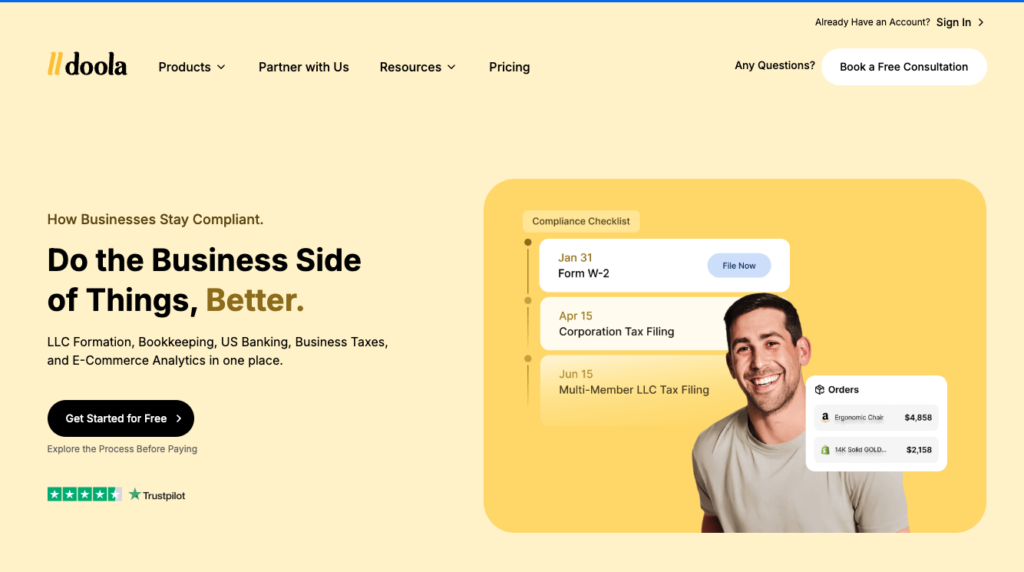
doola is a subscription aimed at non-resident founders who want to bundle formation, bookkeeping, and tax filing into a single recurring plan. It’s one of the competitors closest to the “all-inclusive” proposition Globalfy also follows, although with more focus on product tools than on guided human support.
Best For
- Remote founders who prefer a single subscription to several providers
- Companies that already earn enough to justify monthly bookkeeping
- Those who value a well-built self-service product
Key Features
- Formation included from an annual subscription plan
- Bookkeeping and tax preparation bundled on the higher plan
- Its own dashboard to track obligations and documents
Why It Stands Out
doola is one of the most complete options on the market aimed specifically at non-resident founders, with a subscription model that tries to handle formation and compliance in the same account.
Pros
- Designed from the start for founders outside the U.S.
- Bookkeeping and tax filing available under the same contract
- Fast self-service onboarding for those who already know what they need
Cons
- The full plan with bookkeeping and taxes sits well above the entry subscription, at around $1,999/year
- Support mostly in English, with no native Portuguese support
- A model geared more to self-service than to a dedicated account executive
Pricing
Plans start at about $297/year for formation and basic maintenance. The Tax and Compliance plan, with bookkeeping and tax filing, runs around $1,999/year.
Final Verdict
It’s a Bizee alternative genuinely built for non-residents, and worth comparing directly with Globalfy on entry-plan price. The difference shows up in the support language and in the price jump between the basic plan and the full-compliance plan.
5. LegalZoom

Overview
LegalZoom is one of the most recognized legal services brands in the U.S., with company formation being just one part of a catalog that includes wills, immigration and intellectual property. Its strength is access to attorneys, not tax compliance for non-residents.
Best For
- Those who want access to broad legal consultations beyond company formation
- Companies that will also need other legal services in the U.S.
- Founders who prefer a large, well-known brand
Key Features
- Basic (free plus state fee), Pro ($249) and Premium ($299) plans
- Access to 30-minute legal consultations on the higher plans
- A broad catalog of legal documents and services beyond formation
Why It Stands Out
LegalZoom is one of the most recognized options on the market and one of the few formation services offering direct access to attorneys for broader legal questions, not just formation.
Pros
- An established brand with decades of operation
- Access to attorneys on the Pro and Premium plans
- A catalog of legal services beyond company formation
Cons
- No bundled preparation of Form 5472, the pro forma 1120, or the 1040NR for non-residents
- Registered agent sold separately, around $249/year
- No native Portuguese or Spanish support
Pricing
Basic is free, but carries the state fee. Pro costs $249 and Premium $299, both plus the state fee. The registered agent renews separately, around $249/year.
Final Verdict
It makes sense for those who value access to general attorneys more than non-resident-specific tax compliance. For the focus of this article, formation plus non-resident taxes handled in the same place, LegalZoom leaves that part out, just like Bizee.
How to Choose the Best Bizee Alternative for Your Profile
1. Check Whether the Non-Resident Filing Is Included
Ask directly: does the plan prepare and file Form 5472, the pro forma 1120, and, if it applies to you, the 1040NR? If the answer is no, you’ll need to hire that separately, and that cost rarely appears on the pricing page.
2. Check the Support Language
Support in English handles most forms. But when a question about entity structure or an IRS notice comes up, understanding every word in your own language changes how fast you solve the problem.
3. Add Up the Total Cost of Year One and Year Two and the Credits
A $0 plan in year one can cost more in year two, when the registered agent renews and tax filings enter the picture. Ask for the two-year total before deciding, not just the formation price.
Also look at what comes with the plan. Globalfy includes more than $200k in credits from partners such as Stripe, Google Ads and OpenAI, plus a free Fynance license ($360). Using just two or three of these benefits, for example the Stripe discount (up to $500) plus the $1,000 OpenAI credit, already covers a good part of the annual Remote subscription. Stripe Atlas and Firstbase also offer partner perks, so compare them on the same basis alongside each plan’s total cost.
4. Evaluate Help With Opening a Bank Account
Without an SSN, opening a U.S. bank account requires a specific partner. Confirm whether the provider has a direct integration with banks that accept non-residents, such as Mercury, Lili or Revolut, and whether you can start even before the EIN is issued.
5. Look at the Compliance Calendar
The Annual Report, Franchise Tax, and federal deadlines have different dates by state and entity type. A provider with automatic reminders keeps you from discovering a missed obligation only when the penalty has already arrived.
6. Read Reviews Looking for Your Specific Problem
Don’t just look at the overall Trustpilot score. Filter by “non-resident”, “5472” or your language and see what people in your situation are saying. A provider can have thousands of reviews from U.S. customers happy with formation and still have very few from foreign founders talking about the tax side – which is exactly the point you’re evaluating.
Everything You Need to Know About Bizee Alternatives
| Company | Pros | Cons | Ease of Use | Non-Resident Support | Languages | Entry Price | Real Cost With Compliance |
| Globalfy | All in one dashboard, support in EN/PT/ES, compliance included | Covers 6 states, Remote plan exclusions | ⭐⭐⭐⭐⭐ | ⭐⭐⭐⭐⭐ | ⭐⭐⭐⭐⭐ | ⭐⭐⭐ | ⭐⭐⭐⭐⭐ |
| Stripe Atlas | Strong brand, partner credits | C-Corp only, zero compliance afterward | ⭐⭐⭐⭐ | ⭐⭐ | ⭐⭐ | ⭐⭐⭐⭐ | ⭐⭐ |
| Firstbase | Modular, positioned for non-residents | Scattered add-ons, unpredictable cost | ⭐⭐⭐ | ⭐⭐⭐ | ⭐⭐ | ⭐⭐⭐⭐ | ⭐⭐⭐ |
| doola | Designed for non-residents, bookkeeping included | Price jump on the full plan | ⭐⭐⭐⭐ | ⭐⭐⭐⭐ | ⭐⭐ | ⭐⭐⭐⭐ | ⭐⭐⭐ |
| LegalZoom | Established brand, access to attorneys | No non-resident tax compliance | ⭐⭐⭐ | ⭐⭐ | ⭐⭐ | ⭐⭐⭐⭐ | ⭐⭐ |
Switch to Globalfy: the Bizee Alternative Built for Non-Residents
Switching providers doesn’t have to mean starting from scratch. Globalfy moves the registered agent and address of your existing company, updates whatever is needed with the state and the IRS, and brings your non-resident tax filings up to date from there.
More than 10,000 founders in more than 100 countries already use the same dashboard to form, bank, and file taxes, with a 4.9 out of 5 Trustpilot rating from more than 700 reviews. And before comparing sticker prices alone, remember: the more than $200k in partner credits included in the plan, such as Stripe, Google Ads, OpenAI and others, can cover a good part of the annual plan.
Talk to a Globalfy specialist and find out which plan covers exactly what your company needs this year.
This article is for information only and doesn’t replace personalized legal, accounting or tax advice. Penalty amounts, deadlines and tax obligations should be confirmed with a qualified professional before any decision.
Frequently Asked Questions About Bizee Alternatives
What is the best Bizee alternative for non-residents in 2026?
The best Bizee alternative for non-residents in 2026 is Globalfy, because it brings formation, a registered agent, a bank account, and non-resident tax filings (5472, pro forma 1120, and 1040NR) into a single plan. Bizee handles formation well, but none of its plans include tax filing, which is mandatory even with no revenue. Bizee supports English and Spanish, but not Portuguese, and neither language option includes non-resident tax specialists. The right choice depends on your profile: remote single member, multiple members, or a startup seeking capital.
What should I consider when choosing an Incfile alternative for my profile?
When choosing an Incfile alternative, consider three main factors: whether the non-resident tax filing is included in the plan, what language support is offered, and the total cost including the second-year renewal. A plan that’s cheap at formation can get expensive once you add a separate accountant for Form 5472. Also check whether there’s an integration with banks that accept non-residents, such as Mercury, Lili or Revolut. Together, these points explain most of the real price difference between providers.
How does Globalfy differ from Bizee and other alternatives?
Globalfy stands apart by including non-resident tax filings in the plan, instead of selling that service separately like most competitors. Its human support in English, Portuguese and Spanish, with a named account executive, is also a differentiator versus providers that support only English, or English and Spanish as Bizee does. Add to that the automatic compliance calendar and access to partner banks such as Mercury, Lili and Revolut even before the EIN is issued. The result is less coordination between different providers throughout the year.
How do I switch from Bizee to Globalfy?
To switch from Bizee to Globalfy, a specialist reviews the current situation of your LLC or Corporation and updates the registered agent and address with the state and the IRS. The process covers existing companies, including cases with late tax filings. You don’t lose your EIN or need to re-form the company from scratch. The first step is a conversation with the team to map exactly what needs to be brought up to date.
Is it easy to switch from Bizee to Globalfy in the middle of the tax year?
Yes, you can switch from Bizee to Globalfy at any point in the tax year, including companies whose registered agent is still active with another provider. The Globalfy team takes over the state update and organizes pending filing deadlines, even if the year is already underway. You don’t need to wait for your current plan’s annual renewal to start the switch. The sooner the migration happens, the lower the risk of missing an IRS deadline mid-process.
Does Bizee serve companies with non-resident members?
Yes, Bizee forms LLCs and Corporations for non-resident members, since there’s no federal citizenship or residency requirement to form a company in the U.S. What Bizee doesn’t do is prepare the specific tax filing that situation requires, such as Form 5472 and the pro-forma 1120. That means a foreign member forming a company through Bizee needs to hire someone separately to handle that filing every year. Without it, the risk of a $25,000 penalty for non-filing exists even when the company was formed correctly.
Are Bizee and Incfile the same company?
Yes, Bizee and Incfile are the same company. Incfile, founded in Houston in 2004, was renamed Bizee at the end of 2023, keeping the same team, the same formation infrastructure and the same prices at the time of the transition. Old Incfile accounts were migrated automatically to Bizee, and the incfile.com domain redirects to bizee.com. Reviews from before 2023 that mention Incfile still describe Bizee’s current service.