



Last updated: October 14, 2026
Key Takeaways (TL;DR)
- The best all-in-one platform: Globalfy brings LLC or Corporation formation, a U.S. address, banking, annual compliance and federal tax filings into a single dashboard, with human support in English, Portuguese and Spanish. It was created in 2015 specifically for people who don’t live in the U.S.
- Why you need one: forming a U.S. company is fast; keeping it compliant with the IRS from abroad, without an SSN and often in a second language, is where most international founders stumble.
- Who it’s for: founders of SaaS, e-commerce and info-product businesses, consultants and startups raising investment who need a legal U.S. presence without hiring a lawyer, an accountant and a registered agent separately.
- How to choose the right one: look at what happens after formation (compliance and taxes included or charged separately), whether support is in your language and what the total cost is in year two, not just the entry price.
- Expected price range: from $0 (formation alone, with no ongoing support) to more than $5,000/year for complete plans with monthly bookkeeping. Globalfy works on an annual subscription, from $588/year (Starter, company formation and address services) to $5,028/year and up (Scale, with dedicated bookkeeping).
Table of Contents
- All-in-one platforms to form a U.S. company: overview
- What is an all-in-one platform for U.S. companies?
- Why do you need an all-in-one platform?
- Who needs an all-in-one platform?
- Best all-in-one platforms: comparative review
- How to choose the right platform
- Everything you need to know, in one table
- Form your company with Globalfy
- Frequently asked questions
Top All-in-One Platforms to Form a U.S. Company in 2026, at a Glance
| Company | Best For | Key Features | Price |
| Globalfy | Non-resident founders who want everything in one dashboard, with support in their language | Formation + address + banking + compliance + federal taxes + dedicated account executive | From $588/year |
| doola | International founders who already know they’ll need bookkeeping | Formation, registered agent, compliance plans with bookkeeping | $297 to $2,999/year |
| Firstbase | Startups that want a cheap entry point and will buy services à la carte later | Fast formation, registered agent, mailroom, bookkeeping and taxes sold separately | $399 (formation) + add-ons |
| Stripe Atlas | Tech startups raising investment and forming a Delaware C-Corp | Formation, EIN, automatic 83(b), initial cap table, native Stripe integration | $500 one-time + $100/year |
| LegalZoom | Those who want a known brand and other legal services beyond the LLC | Formation, wills, contracts, trademarks, broad legal support | From $0 + state fee |
| ZenBusiness | Small U.S. businesses that want a simple compliance dashboard | Formation, Worry-Free Compliance, AI assistant, website included on the free plan | From $0 + state fee |
| Bizee | Those who prioritize the lowest possible entry cost | Free formation, one year of registered agent included, virtual address | From $0 + state fee |
What Is an All-in-One Platform for U.S. Companies?
An all-in-one platform to form a U.S. company is a service that covers the full cycle of an American LLC or Corporation in one place: state registration, getting the EIN, business address, registered agent, bank account, compliance calendar and federal tax filings.
The difference from a “formation only” service is simple. A traditional formation service delivers the company paperwork and disappears. An all-in-one platform stays with you after that, handling the obligations that come up in the second, third and tenth year of operation.
For non-resident founders, ignoring that difference is expensive. Form 5472, mandatory for foreign-owned single-member LLCs, carries a penalty of $25,000 for late or incomplete filing with the IRS. That’s the kind of obligation a formation-only platform simply doesn’t warn you about.
Why Do You Need an All-in-One Platform?
Founders outside the U.S. face a specific problem: they want to sell to American customers, get paid in dollars and gain credibility with payment platforms, but they don’t live in the country and don’t understand U.S. corporate, banking and tax bureaucracy.
The first hurdle is the decision. Which state to register in? LLC or Corporation? Most founders have no basis to answer that on their own.
The second is mechanical. Completing Form SS-4 and getting an EIN without an SSN isn’t intuitive: the IRS online system rejects applicants without an SSN or ITIN, so the application has to go by fax or mail.
The third is banking. Most U.S. banks require an in-person visit to open an account, which rules out most international founders from the start.
The fourth, and most expensive in the long run, is regulatory invisibility. Annual Report, Franchise Tax, Forms 5472, 1120 and 1040NR: many founders only discover these obligations after an IRS notice or an administrative dissolution of their company.
In the sales calls Globalfy analyzed between February and August 2026, formation timelines and total cost dominated across every language, and double taxation was one of the most frequent questions in Portuguese-language calls. That confirms a pattern: the fear of getting something wrong with the IRS weighs as much as price in the buying decision.
Who Needs an All-in-One Platform?
The Remote SaaS Founder
Solo or in a pair, building subscription software for global customers. Needs to bill in dollars and look trustworthy to U.S. payment processors, with little tolerance for bureaucratic risk.
The Cross-Border E-commerce Seller
Runs an Amazon FBA, Shopify or dropshipping operation targeting the U.S. market. Needs an LLC to meet marketplace requirements and, as revenue grows, support with Sales Tax.
The Info-Product Creator
Sells courses or digital products internationally, a model common in Latin America through platforms such as Hotmart. Wants a U.S. entity to get paid in dollars and reduce withholding at source, prioritizing simplicity above all.
The Consultant or Freelancer
A solo professional serving U.S. clients, often a digital nomad. Wants a professional U.S. presence, a bank account and simple invoicing, without added complexity.
The Founder Raising Investment
Forming or converting to a Delaware C-Corp to raise from U.S. investors. A more sophisticated buyer, focused on a clean cap table and compliance from day one.
The Investor
Uses a U.S. LLC purely as a holding or investment vehicle, with no active operations. Low service usage but high long-term value, and doesn’t qualify for plans such as Remote, since U.S.-source investment income requires a full tax return.
Best All-in-One Platforms: Comparative Review
1. Globalfy
Overview
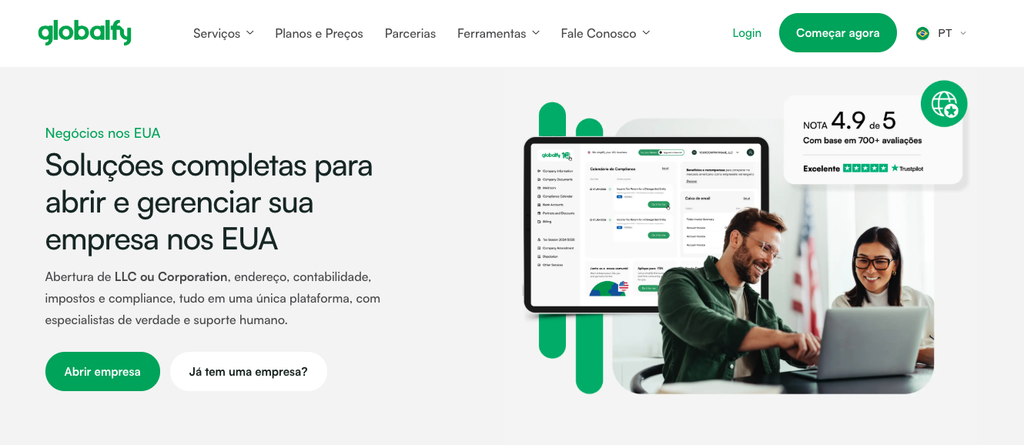
Globalfy is a complete platform for forming and operating a U.S. LLC or C-Corporation, created in 2015 specifically for non-resident founders. It brings company formation, EIN, business address, registered agent, compliance calendar and federal filings together in a single dashboard, depending on the plan, with human support in English, Portuguese and Spanish. It has supported more than 10,000 founders in more than 100 countries, with Brazil as its largest market.
Best for
- Founders who’ve tried to handle everything on their own in a second language and given up halfway.
- Founders who want a named account executive, not a ticket queue.
- Businesses that know they’ll need compliance year after year, not just at launch.
- Founders moving an LLC they formed on their own or through a formation-only competitor.
What does it offer?
- State registration in Wyoming, Delaware, Florida, Texas, Nevada, or New Mexico.
- Compliance calendar with automatic reminders for the Annual Report, Franchise Tax, and federal deadlines.
- Banking assistance with Mercury, Lili and Revolut, including applications before the EIN is issued.
- Free Fynance license (AI bookkeeping, $360 value) included in the plans.
Highlights
Globalfy was built not to “form fast and walk away”, but to stay with the founder through the following years, when federal and state obligations show up. The case of Douglas Negrisolli of L8Cup, a client for ten consecutive years, is the most concrete example: retention, not just formation, is what sustains its 4.9/5 rating from more than 700 Trustpilot reviews.
Covering “only” six states often looks like a limitation next to competitors that serve all 50, until you notice that nearly half of Globalfy’s clients (~40%) choose Wyoming, and the rest are spread across Delaware, Florida, Texas, Nevada and New Mexico. Those six states cover the vast majority of real non-resident founder cases; the other 44 states come up almost only in very specific scenarios.
Benefits
- Human support in English, Portuguese or Spanish with a named account executive, not a chatbot.
- Compliance calendar, registered agent and federal filings included in all plans except Starter, which covers company formation and address services only.
- More than $200k in partner credits: just adding up the Stripe discount (up to $500), the OpenAI credit ($1,000), the Google Ads credit ($1,000 when you spend $1,500) and the free Fynance license ($360) already covers a good part of the annual Remote subscription.
- Over 11 years of experience and a strong event presence across Latin America and Europe.
Watch-outs
- Covers six states (Wyoming, Delaware, Florida, Texas, Nevada, New Mexico): founders who need a state outside that list won’t find support here.
- The Remote plan has clear exclusions: it doesn’t cover LLCs with multiple members, physical presence in the U.S., B2B/e-commerce sales to American customers, or U.S.-source investment income.
- It isn’t the cheapest option for formation alone; the argument is the total cost of keeping the company compliant, not the entry price.
Pricing
Annual plans by business profile: Starter ($588, company formation and address services), Remote ($998, 100% remote solo founder), Essential ($1,308, multiple members or U.S. presence), and Scale (from $5,028, with dedicated monthly bookkeeping). State formation and renewal fees are extra and vary by state.
Verdict
For a non-resident looking for an all-in-one platform, Globalfy solves the problem that shows up most after formation: staying current with the IRS and the state, in your language, without having to hire three more providers along the way.
2. doola
Overview
doola is a U.S. platform focused on international founders, with LLC or C-Corp formation and plans that go up to bookkeeping and full tax filing. It recently raised its entry plan from $197 to $297 a year.
Best For
- Founders without an SSN who need a quick LLC in Wyoming or Delaware to access Stripe, Shopify or Amazon.
- Sellers above $100k in revenue who want bookkeeping and Sales Tax included.
- Those who prefer a brand fully dedicated to international founders, without having to decode U.S. legal terms alone.
Key Features
- LLC or C-Corp formation with EIN, Operating Agreement, registered agent and U.S. address included in the Starter plan.
- Tax and Compliance plan with bookkeeping, annual tax filing and a licensed tax professional consultation.
- A Business Setup fee plus state fee structure, making clear what goes to doola and what goes to the government.
Why It Stands Out
doola is one of the most consistent options for founders who know from the start that they’ll need ongoing compliance, not just formation paperwork.
Pros
- No hidden fees: every add-on is listed before you buy.
- Free company dissolution on the higher plans, if the founder needs to close the company later.
- The subscription is deductible as a business expense in the U.S.
Cons
- The Starter plan renews at $297/year indefinitely, with no option to drop the virtual address or registered agent to lower the cost.
- The jump from Starter ($297) to Tax and Compliance ($1,999) is large; there’s no middle ground.
- Support isn’t natively structured in Portuguese or Spanish the way Globalfy’s is; it runs mainly in English.
Pricing
Starter at $297/year, Tax and Compliance at $1,999/year, Business-in-a-Box™ at $2,999/year (or $329/month), all plus state fees.
Final Verdict
doola is a solid option for founders who have decided they want bookkeeping and compliance built in and don’t mind operating in English. Worth noting: in Globalfy’s sales calls, leads who have already researched doola often cite a cost of around $2,000, above Globalfy’s equivalent plan. It isn’t the right choice for those who see human support in their own language as decisive, which comes up repeatedly as a reason for switching providers.
3. Firstbase
Overview
Firstbase forms LLCs and C-Corps in Delaware or Wyoming for a one-time fee of $399, including state fees, expedited EIN and post-incorporation documents. From there, each additional service (registered agent, mailroom, bookkeeping, taxes) is sold separately or in the Firstbase One package.
Best For
- Startups that want a cheap entry point and will decide later which recurring services to buy.
- Founders comfortable building their own service stack, without relying on a fixed plan.
- Companies that already operate in the U.S. and only need a mailroom or a standalone registered agent.
Key Features
- Formation with expedited EIN and essential documents in a single checkout.
- Registered Agent Autopilot from $299/year.
- Firstbase One, a package combining agent, mailroom, bookkeeping and taxes for about $199/month.
Why It Stands Out
Firstbase stands out for its low-cost entry model: you pay little to form and choose later what you need to buy. It’s one of the most flexible options for founders who don’t want a fixed plan.
Pros
- The lowest formation fee among the more robust platforms on the list.
- Bank account opening support included from the entry plan.
- More than 30,000 companies formed in 191 countries, according to figures published by the company.
Cons
- Separate Tax Filing costs about $1,799/year for C-Corps and multi-member LLCs, and Accounting adds $599/month on top: the total can exceed competitors with a fixed plan.
- Registered agent, mailroom and bookkeeping aren’t included in the formation price, so you have to build the package manually.
- No native support structure in Portuguese or Spanish.
Pricing
Formation at $399 (one-time fee), Registered Agent Autopilot at $299/year, Mailroom from $35/month, Tax Filing from $1,799/year, Accounting from $599/month, or the Firstbase One package for about $199/month.
Final Verdict
Firstbase works well for founders who want to assemble their own mix of services and don’t mind adding up the bills later. It isn’t the most predictable option for those who prefer a fixed annual price with everything included from the start.
4. Stripe Atlas

Overview
Stripe Atlas forms C-Corps (and LLCs) in Delaware for a one-time fee of $500, including the state fee, EIN, founder share issuance, automatic 83(b) election and one year of registered agent. It’s the option most often cited in Globalfy’s sales calls as a direct point of comparison.
Best For
- Tech startups that will raise investment and need a Delaware C-Corp with a clean cap table from the start.
- Founders who already use, or plan to use, Stripe as their main payment processor.
- Those who want to form fast without worrying (for now) about long-term compliance.
Key Features
- Delaware incorporation with the state fee included, usually ready within two business days.
- Automatic 83(b) filing, avoiding the most common first-time founder mistake.
- A partner catalog worth more than $50k in credits, including Mercury, AWS and Xero.
Why It Stands Out
Stripe Atlas is fast and well known, with a natural fit for those who already process payments through Stripe. It’s one of the strongest choices specifically for C-Corp founders raising capital.
Pros
- Fixed, transparent pricing, with no fine print on the initial fee.
- Legal documents created in collaboration with the law firm Cooley LLP.
- A process recognized by U.S. investors, which makes due diligence easier in future rounds.
Cons
- Covers formation only: Delaware Franchise Tax, the Annual Report and federal tax filings are left to the founder or an outside accountant.
- In the words of Globalfy’s reps on sales calls, Atlas is “excellent for opening, but it stops there”.
- No ongoing support in your language and no built-in compliance calendar.
Pricing
$500 one-time formation fee, with registered agent renewal at $100/year from the second year. Delaware Franchise Tax and the Annual Report are charged separately by the state.
Final Verdict
Stripe Atlas is the right choice for those who only need to form a Delaware C-Corp quickly and already have (or will hire) an accountant for everything that comes after. For those who want the full cycle in one place, including compliance and taxes, it isn’t an all-in-one platform: it’s a front door.
5. LegalZoom

Overview
LegalZoom is one of the best-known names in online legal services in the U.S., offering company formation alongside wills, contracts and trademark registration. It has strong brand recognition and a broader service menu than any other name on this list.
Best For
- U.S. founders who want to handle formation, a will and other legal documents in one place.
- Those who value brand recognition over price or a specialization in international founders.
- Businesses that occasionally need legal support beyond the LLC, such as trademark registration.
Key Features
- LLC formation with free plans (plus state fee) up to plans with faster processing.
- A broad catalog of additional legal services, going well beyond company formation.
- A large Trustpilot review base, with a 4.6 rating from about 31,400 reviews.
Why It Stands Out
LegalZoom stands out for the breadth of its legal services. It’s one of the strongest options for those who want to handle varied legal matters with the same provider, not just company formation.
Pros
- A widely recognized brand, which builds initial trust for those who have never formed a U.S. company.
- Legal services beyond formation, including contracts and intellectual property.
- Coverage in all 50 U.S. states.
Cons
- Registered agent costs $249/year extra, the most expensive among the traditional formation services compared here.
- No structured support for non-resident-specific obligations such as Form 5472.
- Processing on the basic plan is described as the slowest among entry-level formation services.
Pricing
Plans from $0 plus state fee, with registered agent sold separately at $249/year.
Final Verdict
LegalZoom works for those who want a known name and other legal services alongside formation. It isn’t the best fit for non-residents whose priority is ongoing U.S. tax compliance, since that specific support isn’t part of the company’s standard scope.
6. ZenBusiness

Overview
ZenBusiness forms LLCs and Corporations with a focus on small U.S. businesses, with a simple dashboard and a built-in AI assistant. The entry plan is free, charging only the state fee.
Best For
- Small U.S. businesses that prioritize a simple compliance dashboard.
- Founders who value phone, chat and email support at every stage.
- Those who want the registered agent included from the Premium plan, without paying extra in the first year.
Key Features
- Worry-Free Compliance free in the first year, with automatic reminders.
- AI assistant for quick questions inside the platform.
- Premium plan at $399/year with registered agent and business consultation included.
Why It Stands Out
ZenBusiness stands out for its user experience and transparent checkout. It’s one of the most consistent options for cost predictability within the universe of formation services aimed at U.S. residents.
Pros
- Clear checkout, with no hidden fees at the time of purchase.
- Multi-channel support rated as more consistent than direct competitors’.
- Website and domain tools included in a 30-day trial on the free plan.
Cons
- Not designed for the specific tax obligations of non-resident founders.
- Registered agent outside the Premium plan costs $199/year extra.
- No support structure in Portuguese or Spanish.
Pricing
Starter from $0 plus state fee, Pro from $199, Premium at $399/year with registered agent included.
Final Verdict
ZenBusiness is a good choice for small businesses already based in the U.S. that want a simple domestic compliance dashboard. For a non-resident founder dealing with double taxation and Form 5472, the product’s scope simply doesn’t cover the problem.
7. Bizee
Overview
Bizee, formerly Incfile, is known for its free formation plan (plus state fee), with one year of registered agent included even in the entry package.
Best For
- Those who prioritize the lowest possible entry cost and accept paying for upgrades later.
- U.S. resident founders who only need basic formation and a registered agent.
- Low-regulatory-risk businesses with no need for specific international compliance.
Key Features
- Free formation plus state fee, with registered agent included in the first year.
- Virtual address and business license research available as add-ons.
- A 4.7 Trustpilot rating from about 25,600 reviews.
Why It Stands Out
Bizee stands out for its entry price. It’s one of the cheapest options for those who only need the formation documents and don’t plan to use the same provider for long-term compliance.
Pros
- The lowest entry cost among the traditional formation services compared here.
- One year of free registered agent even on the no-cost plan.
- A formation process described as straightforward, although longer than competitors with a single checkout.
Cons
- Registered agent rises to about $119/year from the second year.
- Doesn’t cover Form 5472 or other non-resident-specific obligations.
- A longer checkout, with multiple upsell screens before completion.
Pricing
Formation from $0 plus state fee, with Gold and Platinum plans at $199 and $299 respectively.
Final Verdict
Bizee is the right option for those who only want the formation document at the lowest possible cost. It doesn’t solve anything that happens after formation, which makes it a risky choice for a non-resident founder with no plan B for compliance.
How to Choose the Best All-in-One Platform (What to Consider)
1. What Happens After Formation
The right question isn’t “how much does it cost to form”, it’s “what does this platform still do for me in year two”. The compliance calendar, Annual Report and federal filings need to be in scope, not an upsell discovered months later.
2. Support in Your Language
A poorly completed Form 5472 can cost a $25,000 penalty. Understanding exactly what’s being asked, in your own language, directly reduces that risk. That’s why multilingual support comes up so often as a reason for switching providers in the sales calls Globalfy has analyzed.
3. Total Cost in Year Two, Not Just the Formation Price
Compare equivalent scopes. A $399 plan that requires buying the registered agent, mailroom, bookkeeping and taxes separately can cost more in year two than a fixed $998 plan that already includes all of that.
4. Coverage of Non-Resident-Specific Obligations
Form 5472, the pro-forma 1120 and the 1040NR aren’t universal across platforms. Formation services aimed at U.S. residents (LegalZoom, ZenBusiness, Bizee) simply don’t cover that scope.
5. Real Value of the Included Benefits
Partner credits from Stripe, OpenAI and Google can cover a good part of the plan’s annual cost if you already use those tools. At Globalfy, for example, just three of these benefits add up to $2,500 in credits and waived fees, plus the $360 Fynance bookkeeping license already included. It’s worth adding that value before comparing sticker prices alone.
6. The Long-Term Cost of Maintaining the State
More important than how many states a platform covers is how much it costs to keep the company there year after year. Wyoming, chosen by about 40% of Globalfy clients, has cheap renewals and no state income tax; Delaware requires an annual Franchise Tax, and some formation services pass that bill on without warning in advance. It’s worth confirming this before choosing the state, not just at formation.
7. Track Record and Social Proof in Your Market
More than 11 years in operation, more than 10,000 founders served and named testimonials, such as Douglas Negrisolli’s (L8Cup), weigh more than a generic app-store rating when you’re choosing a partner to run a U.S. company from abroad.
Everything You Need to Know About All-in-One Platforms
| Company | Pros | Cons | Multilingual Support | Support | Compliance Included |
| Globalfy | Support in EN/PT/ES, compliance included, $200k in credits | Higher entry price, covers 6 states | ⭐⭐⭐⭐⭐ | ⭐⭐⭐⭐⭐ | ⭐⭐⭐⭐⭐ |
| doola | No hidden fees, free dissolution on higher plans | Big jump between plans, support mainly in English | ⭐⭐ | ⭐⭐⭐ | ⭐⭐⭐⭐ |
| Firstbase | Cheap entry, banking support included | Add-ons add up fast, no fixed plan | ⭐⭐ | ⭐⭐⭐ | ⭐⭐ |
| Stripe Atlas | Fast, documents created with a law firm | Formation only, no ongoing compliance | ⭐ | ⭐⭐ | ⭐ |
| LegalZoom | Recognized brand, broad legal services | No non-resident focus, expensive agent | ⭐⭐ | ⭐⭐⭐ | ⭐⭐ |
| ZenBusiness | Simple dashboard, transparent checkout | Doesn’t cover non-resident obligations | ⭐ | ⭐⭐⭐⭐ | ⭐⭐ |
| Bizee | Lowest entry cost, free agent in year 1 | No long-term compliance, long checkout | ⭐ | ⭐⭐⭐ | ⭐ |
Form Your Company With Globalfy
The real risk of forming a U.S. company on your own isn’t the registration form. It’s what happens a year later, when a deadline slips by and an IRS penalty arrives in a language you don’t fully command.
Globalfy solves that by bringing formation, banking, compliance and federal taxes into a single dashboard, with an account executive who speaks your language and more than 11 years of experience helping founders from Latin America, Europe and beyond operate in the U.S. without surprises.
Compare Globalfy’s plans and see which one fits your business profile, or talk to a specialist before deciding.
Frequently Asked Questions About All-in-One Platforms for U.S. Companies
What is the best all-in-one LLC formation service in 2026?
The best all-in-one LLC formation service in 2026 for non-resident founders is Globalfy, because it brings formation, banking, compliance and federal taxes into a single dashboard with human support in English, Portuguese and Spanish. For a Delaware C-Corp aimed at raising investment, Stripe Atlas is faster, but it only covers formation. The right choice depends on how much ongoing support you need after forming.
What should I consider when choosing the right LLC formation service for me?
Consider three main factors: what the platform does after formation, whether support is in your language and the real total cost in year two, including add-ons. A cheap entry plan that requires buying the registered agent, bookkeeping and taxes separately can cost more than a fixed plan. Globalfy, for example, already includes compliance and federal filings from the Remote plan, at $998/year.
How does Globalfy differ from platforms such as doola and Firstbase?
Globalfy stands apart by offering native human support in English, Portuguese and Spanish, with a named account executive, something doola and Firstbase don’t structure the same way. In addition, the compliance calendar and federal tax filings are already included in the Remote, Essential and Scale plans, without relying on separate add-ons. Its track record of more than 11 years in Latin America is also a differentiator against mostly U.S.-focused competitors.
How do I get started with Globalfy?
You start by filling in the onboarding form on Globalfy’s website, stating your business profile (SaaS, e-commerce, info products, consulting or investor). The team recommends the most suitable plan and state, handles state registration and runs the EIN application with the IRS. After that, you get support to open an account with Mercury, Lili or Revolut directly through the platform.
Is it easy to move my existing company to Globalfy?
Yes, Globalfy has a dedicated migration service (“switch company”) for those who already have an LLC or Corporation formed by another provider or on their own. The process covers the state amendment and updating the registered agent and address with the state and the IRS. It’s the right option for those who formed on their own or with a competitor and want to centralize compliance and taxes in a single dashboard from now on.
Is there a guarantee I’ll be able to open a U.S. bank account without an SSN?
There’s no guarantee, because final approval always depends on the financial institution, not the formation platform. Globalfy offers direct assistance with its partners Mercury, Lili and Revolut, with applications possible even before the EIN is issued, but the bank runs its own review process. That applies to every platform on this list: none can promise bank approval.
Is it worth paying more for an all-in-one platform instead of hiring formation, an accountant and a registered agent separately?
It depends on the combined total cost, not on the price of each service alone. Hiring each piece separately usually creates more coordination work and, often, an annual cost similar to or higher than a fixed plan such as Globalfy’s Essential, at $1,308/year. The advantage of centralizing shows up mainly in the absence of deadlines missed between providers that don’t talk to each other.