



Last updated: October 14, 2026
Selling courses on Hotmart, Teachable or Kajabi seems simple until the money stops landing in your account the way you expected. Many creators outside the U.S. only discover they need a U.S. company when a platform withholds part of a payment, when the payment gateway blocks their personal account, or when their accountant warns that reporting everything as an individual has become a problem. In this guide, we compare the main services for forming an LLC as a content creator, including real costs, timelines and what each one solves (or doesn’t) after formation.
Key Takeaways (TL;DR)
- The best overall option: Globalfy is the best fit for creators because it brings LLC formation, a bank account, annual compliance and federal filings into a single dashboard, with human support in English, Portuguese and Spanish – the problem that shows up most in the first 12 months for those who only formed the company and didn’t think about the following year.
- Why you need it: without a U.S. LLC, platforms such as Stripe and PayPal may restrict accounts held by individuals outside the U.S., and you’re exposed to tax withholding and double the paperwork between your country and the U.S.
- Who it’s for: content creators, course creators, coaches and affiliates who earn, or plan to earn, in dollars through U.S. or international platforms.
- How to choose the right one: weigh three points: what happens after formation (compliance and taxes), whether support is in your language, and whether the advertised price already includes first-year obligations.
- Expected price range: Globalfy charges a fixed annual subscription by business profile, not a percentage of your revenue. Plans range from $588/year (company formation and address services) to $1,308/year (multiple members or U.S. presence), with a Scale plan from $5,028/year for those with high volume. Across the market, competitors range from $297/year (basic formation, no bookkeeping) to more than $2,000/year once you add the compliance add-ons.
Best Companies for Forming a U.S. Company as a Content Creator in 2026, at a Glance
| Company | Best For | Key Features | Price |
| Globalfy | Creators who want formation + compliance + support in their language in one place | LLC, EIN, account with Mercury/Lili/Revolut, compliance calendar, federal filings, dedicated account executive | $588–1,308/year |
| Stripe Atlas | Those already in the Stripe ecosystem who only need a Delaware C-Corp | Delaware formation, EIN, 83(b) election, first year of registered agent | $500 one-time fee + $100/year |
| Firstbase | Creators already operating at larger scale who accept building compliance à la carte | LLC or C-Corp, registered agent, mailroom, bookkeeping and taxes sold separately | $399 one-time fee + subscriptions from $299/year |
| doola | Those who want the cheapest basic package and are willing to buy compliance later | LLC, EIN, registered agent, U.S. address, compliance alerts | $297/year (basic plan) |
| LegalZoom | Those who already know the U.S. market and want one-off legal consultations | LLC formation, legal documents, attorney consultations (higher plans) | $0–299 + state fees |
What Is a U.S. Company Formation Service?
A U.S. company formation service for creators handles the state registration of your LLC or Corporation, the EIN application (the company’s federal tax ID) with the IRS and, depending on the provider, items such as a business address, registered agent and annual tax obligations.
For those living outside the United States, this process has an extra complication. The IRS online system for requesting an EIN requires an SSN or ITIN – numbers most creators abroad don’t have. Without one, the application has to go by fax or mail, which most generic providers don’t handle well. That’s exactly the niche – formation for non-residents – that companies such as Globalfy, doola and Firstbase solve.
Why Does a Creator Need a U.S. Company?
The pressure usually comes from the payment platform itself. Stripe and PayPal increasingly restrict accounts held by individuals outside the U.S. selling to American audiences, and international info-product marketplaces ask for a formal entity to release larger payouts or reduce withholding at source.
There’s also the tax question. A creator who gets paid in dollars without a U.S. structure may face more withholding than necessary, especially if their country has no tax treaty with the U.S. and payments default to the standard rate for foreigners. A properly structured non-resident LLC can change how those payments are treated, although the result depends on your case.
The IRS also doesn’t forgive those who ignore post-formation obligations. Failing to file Form 5472, required of every non-resident single-member LLC, carries a $25,000 penalty per year – even if the company earned nothing. That’s the kind of trap that separates a service that only forms the company from one that follows it all year.
Who Needs a U.S. Company as a Content Creator?
Online Course Creator
Sells recorded or live courses on platforms such as Hotmart, Teachable or Kajabi, usually alone or with a small team. Needs an LLC to get paid in dollars with less withholding friction and to open a U.S. bank account without visiting the U.S.
Coach or Mentor
Sells one-on-one or group mentoring, often charging international clients in dollars. Wants a simple structure, with no partners, that doesn’t require heavy bookkeeping at the start.
Affiliate and Launch Specialist
Earns commissions promoting third-party products or runs their own launches with revenue peaks concentrated in a few days. Needs a bank account that can handle those peaks without freezing on suspicion of fraud.
Paid Community Creator
Charges a recurring subscription for access to a private community or members area. Because revenue is monthly and predictable, they tend to move faster to plans with bookkeeping included – and once MRR grows enough, to a plan with dedicated monthly bookkeeping, such as Globalfy’s Scale.
Multi-Platform Creator
Sells on Hotmart, Teachable, ClickBank and international affiliate networks at the same time. Faces the greatest tax complexity in the group and benefits most from a plan with complete federal filings from the first year. At Globalfy, that’s usually Essential, with an upgrade to Scale (from $5,028/year) once volume justifies a dedicated accountant and monthly bookkeeping.
Best Services to Form a U.S. Company: Detailed Comparison
1. Globalfy
Overview
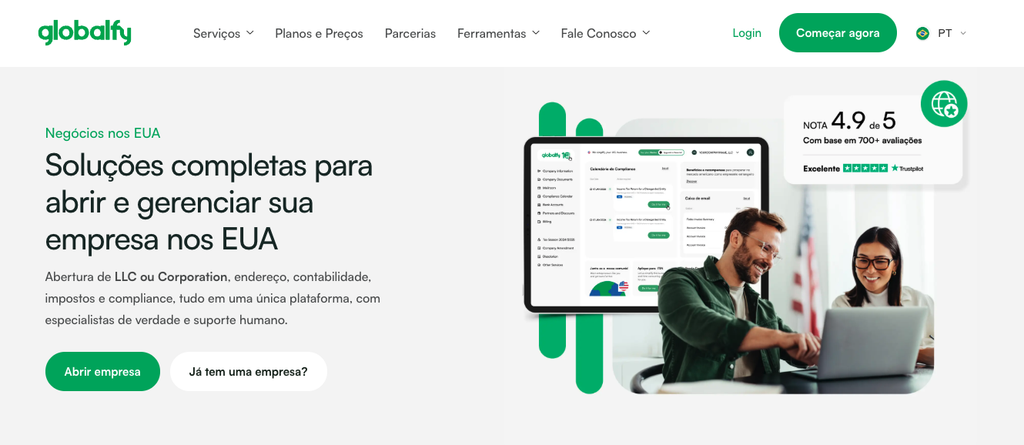
Globalfy is a complete platform for forming and managing a U.S. company, founded in 2015 in Orlando, Florida, and built for non-resident founders – 99% of its client base is outside the U.S. Unlike a service that only forms the LLC and disappears, Globalfy keeps clients in the dashboard for compliance, banking, bookkeeping and tax filings throughout the company’s life, with human support in English, Portuguese and Spanish.
Best For
- Creators selling through Hotmart, Teachable or Kajabi who need a structure to get paid in dollars.
- Those who want to handle formation and compliance in one place, without hiring an accountant, registered agent and bank separately.
- Creators who prefer talking to a specialist in their own language rather than an English-only chat.
Key Features
- LLC or C-Corp registration in Wyoming, Delaware, Florida, Texas, Nevada or New Mexico.
- EIN application and tracking directly with the IRS, with no SSN required.
- Help opening an account with a partner bank (Mercury, Lili or Revolut), even before the EIN is issued.
- A compliance calendar with automatic reminders for the Annual Report, Franchise Tax and IRS deadlines.
- A dedicated account executive, instead of a ticket queue.
- Plans built around the filings a non-resident creator actually needs to submit (5472 + pro-forma 1120 for single-member LLCs; 1040NR when there’s more than one member or U.S.-source income), not a generic model designed for U.S. founders.
Why It Stands Out
Globalfy’s edge for creators isn’t forming the company faster; it’s what comes after. Its base of more than 700 Trustpilot reviews (4.9 out of 5) repeatedly cites fast, patient human support as the reason for switching providers. It’s worth doing the math: Globalfy’s partner marketplace includes waived Stripe fees on the next $20,000 processed (up to $500 in savings), $1,000 in OpenAI API credits, and a $1,000 Google Ads credit after $1,500 spent – together with the free Fynance license ($360 in AI bookkeeping), those benefits can cover a good part of the annual Remote plan ($998/year). Douglas Negrisolli of L8Cup has been a client for ten consecutive years, a rare case among formation-only competitors.
Pros
- Compliance, banking and formation in a single dashboard, without coordinating separate providers.
- Human support in English, Portuguese and Spanish, with a named account executive.
- Partner credits that, in practice, lower the plan’s effective cost.
- More than 11 years of experience and more than 10,000 founders served in more than 100 countries.
Cons
- The entry plan (Starter) covers company formation and address services only; compliance and banking require the Remote plan or higher.
- Not the cheapest option on the market if your only goal is to form the LLC and nothing else.
- The Remote plan has clear exclusions: it doesn’t cover LLCs with multiple members, physical presence in the U.S., B2B/e-commerce sales to American customers, or U.S.-source investment income.
Price
Starter costs $588/year (company formation and address services). Remote, the best fit for a solo creator with no partners, costs $998/year and already includes banking assistance, compliance calendar and the first federal filing (5472 + pro-forma 1120). Essential, for those with partners or a physical presence in the U.S., costs $1,308/year.
Final Verdict
For creators who have already seen how much it costs to rebuild everything after a forgotten Form 5472, Globalfy is the safest choice: it handles formation and the following year in the same contract, in your language.
2. Stripe Atlas
Overview
Stripe Atlas is Stripe’s own company formation product, originally designed for tech startups already using the Stripe ecosystem to process payments. It forms a Delaware C-Corporation, delivers the EIN and handles the 83(b) tax election – relevant for those distributing equity, but rarely used by a solo creator.
Best For
- Creators who already process payments through Stripe and want to keep everything in the same ecosystem.
- Those planning to raise investment in the future who already want a Delaware C-Corp.
- Technical founders comfortable handling compliance themselves after formation.
Key Features
- Delaware formation, with the EIN included.
- 83(b) election already prepared, useful for those who will distribute shares.
- First year of registered agent included in the package.
- Natural integration with an existing Stripe account.
Why It Stands Out
Stripe Atlas is by far the name most often mentioned in the industry’s sales calls – reps describe the service as excellent for forming a company, but limited after that. It’s one of the most recognized options on the market precisely because of that simplicity: you form the company, get the documents and carry on alone.
Pros
- A low entry price and a fast process.
- A recognized brand, which helps in conversations with banks and investors.
- A good fit for those already using Stripe day to day.
Cons
- Only forms companies in Delaware, with no Wyoming or Florida option.
- No ongoing compliance, bookkeeping or annual tax filing – that’s left to the user.
- Self-serve support, with no named account executive.
- A C-Corp means corporate taxation (21%), which rarely pays off for a solo creator selling info products.
Price
A one-time $500 fee at formation, with a $100/year renewal from the second year to keep the registered agent. Stripe also refunds the $500 fee if you deposit $5,000 into a Stripe Treasury account.
Final Verdict
It makes sense for those already living inside Stripe who don’t mind hiring an accountant and registered agent separately later. For creators who want to handle everything with a single provider, in their own language, it isn’t the best fit.
3. Firstbase
Overview
Firstbase is a formation platform aimed at international founders, with more than 30,000 companies formed in 191 countries. Like Globalfy, it offers an LLC or C-Corp in Delaware or Wyoming, but it builds compliance as a set of separate subscriptions rather than a single plan.
Best For
- Creators at a more advanced stage, with enough revenue to justify monthly bookkeeping.
- Those who prefer to build their own service package rather than buy a fixed plan.
- Founders who value a stated EIN timeline (8 to 12 business days).
Key Features
- LLC or C-Corp formation with the state fee included in the first purchase.
- Registered agent, mailroom and bookkeeping sold as independent modules.
- A perks marketplace with more than $350k in partner credits.
- Multiple banking partners and accrual-basis bookkeeping.
Why It Stands Out
Firstbase’s strength is volume: more companies formed than most formation-only competitors, which translates into well-tested processes. It’s one of the most solid choices for those already operating at scale who don’t mind comparing the price of each module separately.
Pros
- A clearly stated EIN timeline.
- A generous credits marketplace.
- Delaware and Wyoming support on the same platform.
Cons
- The final price climbs fast once you add the registered agent, mailroom and bookkeeping separately – the complete package (Firstbase One) comes close to $2,400/year.
- No native Portuguese or Spanish support.
- The advertised formation fee ($399) doesn’t include the mandatory registered agent, bringing the real first-year cost closer to $700.
Price
Formation from $399 (one-time fee). The registered agent costs $299/year extra, mailroom from $35/month, and the complete Firstbase One package costs about $199/month when billed annually.
Final Verdict
A good option for creators who already earn enough to justify formal bookkeeping and don’t mind building their own service package piece by piece. For those just starting who want cost predictability, the à la carte model can bring surprises at year-end.
4. doola
Overview
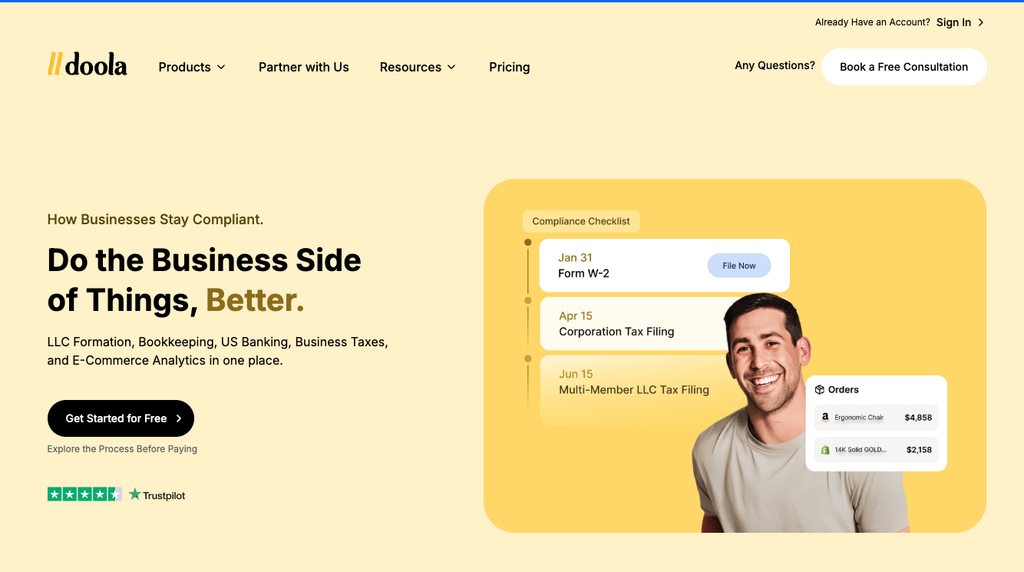
doola is one of the best-known platforms aimed at non-resident founders, with the same target audience as Globalfy: people living outside the U.S. who need an LLC without visiting the country. Its entry plan is one of the cheapest on the market, but full compliance only appears on the higher plans.
Best For
- Creators who want the lowest possible formation cost and don’t need formal bookkeeping yet.
- Those who already know how to handle Form 5472 themselves or with an outside accountant.
- Founders comfortable with support mostly in English.
Key Features
- An LLC or C-Corp in any of the 50 U.S. states.
- EIN with no SSN required.
- Automatic compliance alerts on the basic plan.
- Higher plans with dedicated bookkeeping and an annual tax return.
Why It Stands Out
doola competes directly with Globalfy for non-resident founders, and it’s one of the options most often cited for a low entry price. It’s a solid choice for those who want to test their business model before committing to a bigger annual plan.
Pros
- A basic plan cheaper than most direct competitors.
- Support for any U.S. state, not just Delaware or Wyoming.
- A well-documented, fast formation process.
Cons
- The basic plan ($297/year) doesn’t include bookkeeping or tax filing – for that, you jump to the $1,999/year plan, more expensive than Globalfy’s Remote.
- No dedicated support in Portuguese.
- No named account executive on the entry plan.
Price
Starter costs $297/year + state fees. The Tax and Compliance plan, with bookkeeping and a tax return, costs $1,999/year. The most complete plan (Business-in-a-Box™) reaches $2,999/year.
Final Verdict
It’s worth it for those who want to test forming the LLC with the smallest possible upfront investment, as long as they accept buying compliance separately later on – and at that point, the total cost tends to exceed that of plans that already include everything.
5. LegalZoom

Overview
LegalZoom is the best-known name in the U.S. company formation market, with more than twenty years in business and a catalog that goes well beyond LLCs: wills, trademarks and contracts are also part of the portfolio. It wasn’t designed specifically for non-resident creators, but it often shows up in comparisons because of its brand.
Best For
- Those who already have some experience with U.S. red tape and want one-off legal consultations.
- Creators who will also need trademark registration or standardized contracts.
- Founders who prefer a very established name, even if they pay more for it.
Key Features
- LLC formation from $0 (plus state fees).
- Attorney consultations included on the Pro and Premium plans.
- A library of documents and contract templates.
- Trademark registration service integrated into the same platform.
Why It Stands Out
LegalZoom’s strength is its brand and access to legal advice, something most formation competitors don’t offer. It’s one of the most recognized options for those who value having one-off legal support available within the same contract.
Pros
- An extremely well-known brand, which eases conversations with banks and partners.
- Access to an attorney on the higher plans.
- A portfolio of legal services beyond company formation.
Cons
- The advertised “$0” price rarely reflects the real cost: the registered agent costs $249/year extra, and the total first-year cost usually lands between $500 and $750.
- Not specialized in non-residents or in creators specifically.
- No support in Portuguese and no federal tax compliance included.
Price
The Basic plan is free (plus state fee). The Pro plan costs $249 (one-time fee) and includes an operating agreement and EIN help. The Premium plan costs $299 and adds legal consultations.
Final Verdict
It makes sense for creators already thinking about registering a trademark or who frequently need contracts reviewed by an attorney. For those who just want to form the LLC and keep it compliant year after year, compliance isn’t LegalZoom’s strong suit.
How to Choose the Best Service to Form a U.S. Company as a Creator
1. Look at What Happens After Formation
Forming the LLC is the easy part. What separates a good provider from a future problem is what it offers for the following twelve months: the Annual Report, Franchise Tax and IRS filings. Ask explicitly what’s included in annual compliance before signing.
2. Confirm Support Is Available in Your Language
Much of the friction in the industry’s sales calls comes from founders who switched providers because of robotic or English-only support. If your English isn’t fluent, an account executive who speaks your language changes how well you understand your own business.
3. Calculate the Total First-Year Cost, Not Just the Formation Fee
“$0” or “$297” prices rarely tell the whole story. Add the registered agent, business address and the first tax filing before comparing two providers side by side.
4. Check Whether the Service Understands Withholding on Info Products
Not every formation-only provider knows how to advise on how a non-resident LLC affects withholding on payments from platforms such as Hotmart or Teachable. Ask directly whether the team has handled that scenario before.
5. Check the Included Credits and Partnerships
Partner credits from Stripe, Google Ads and OpenAI can cover a good part of the annual plan cost when used together. It’s worth asking which partnerships the provider offers before deciding on the monthly price alone.
6. See Whether You Get Human Guidance on the Bank Account Application
Several providers say they have a “partnership with Mercury”, but that often just means a referral link. What makes the practical difference is having a specialist guide the documentation before submission and follow the application if the bank asks for something more – which is harder to find outside a plan with a dedicated account executive.
Everything You Need to Know About Forming a U.S. Company as a Creator
| Company | Pros | Cons | Ease of Use | Multilingual Support | Compliance Included | Value for Money |
| Globalfy | All in one dashboard, support in EN/PT/ES, partner credits | Entry plan doesn’t include compliance | ⭐⭐⭐⭐⭐ | ⭐⭐⭐⭐⭐ | ⭐⭐⭐⭐⭐ | ⭐⭐⭐⭐ |
| Stripe Atlas | Recognized brand, Stripe integration | Delaware only, no ongoing compliance | ⭐⭐⭐⭐ | ⭐ | ⭐⭐ | ⭐⭐⭐ |
| Firstbase | Stated EIN timeline, credits marketplace | Separate modules push up the total | ⭐⭐⭐ | ⭐ | ⭐⭐⭐ | ⭐⭐⭐ |
| doola | Cheap basic plan, serves all 50 states | Full compliance only on an expensive plan | ⭐⭐⭐⭐ | ⭐ | ⭐⭐⭐ | ⭐⭐⭐ |
| LegalZoom | Well-known brand, access to an attorney | Not specialized in creators, real price higher than advertised | ⭐⭐⭐ | ⭐ | ⭐⭐ | ⭐⭐ |
Form Your U.S. Company With Globalfy
If your business already depends on getting paid in dollars through Hotmart, Teachable or any other international platform, the risk isn’t forming the wrong company. It’s forming the right company and having no one to explain what to do with it a year later. Globalfy solves both sides: fast LLC formation and a compliance calendar that warns you before any IRS deadline, all in your language.
Talk to a Globalfy specialist and find out which plan fits your sales volume as a creator.
Frequently Asked Questions About Forming a U.S. Company as a Content Creator
What is the best service to form a U.S. company as a content creator?
Globalfy is the best service to form a U.S. company as a content creator because it brings LLC formation, a bank account, annual compliance and federal filings into a single plan, with support in English, Portuguese and Spanish. Competitors such as Stripe Atlas and doola cost less at formation, but leave bookkeeping and tax filing out of the basic plan. For those receiving recurring payments through Hotmart or Teachable, that ongoing support helps avoid the $25,000 penalty for not filing Form 5472.
What should I consider when choosing the best LLC setup as a creator?
Consider three factors: the total first-year cost (not just the formation fee), whether support is in your language, and whether the provider understands how an LLC affects withholding on payments from info-product platforms. A non-resident single-member LLC is usually the simplest structure for those selling alone.
How do I form an LLC to sell on Hotmart?
To form an LLC to sell on Hotmart, choose a state of registration (Wyoming is usually the fastest and cheapest for non-residents), use a service that applies for the EIN without requiring an SSN, and set up a U.S. bank account to receive the platform’s payouts. Hotmart doesn’t require a U.S. company to sign up, but having an LLC can reduce withholding on what you receive and makes it easier to open an account with partner banks such as Mercury.
How does Globalfy differ from similar services?
Globalfy stands apart by offering ongoing compliance, not just company formation, with a dedicated account executive and human support in English, Portuguese and Spanish. While competitors such as Stripe Atlas end the relationship after formation, Globalfy tracks the state and IRS obligations calendar all year. That includes more than $200k in partner credits from companies such as Stripe and OpenAI, which help offset the annual plan cost.
Is it easy to switch from another provider to Globalfy?
Yes, it’s easy to switch from another provider to Globalfy through its company migration service, which updates the registered agent and address with the state and the IRS. The process covers those who formed their LLC on their own or through another formation-only provider and want to centralize compliance, banking and bookkeeping in a single dashboard.
Does withholding on Hotmart payments change if I have a U.S. LLC?
Yes, the way you receive payments can affect withholding on international payments, and a U.S. pass-through LLC is one way to avoid more withholding than necessary, compared with getting paid as an individual abroad with no formal U.S. entity. The exact result depends on your case: volume, the paying platform and how the income is reported in your country. That’s why this specific treatment should be confirmed with an accountant who understands taxation between your country and the U.S. before making any decision based on it.
Do I need a U.S. visa to form an LLC as a foreign creator?
No, you don’t need a U.S. visa to form an LLC as a foreign creator. The process is fully remote, and the only personal document usually required is a passport. Formation itself usually takes 1 to 7 business days in Wyoming, while the EIN, applied for without an SSN, comes through in 2 to 3 business days under the most common process for non-residents.